Everybody Plans the Corpse
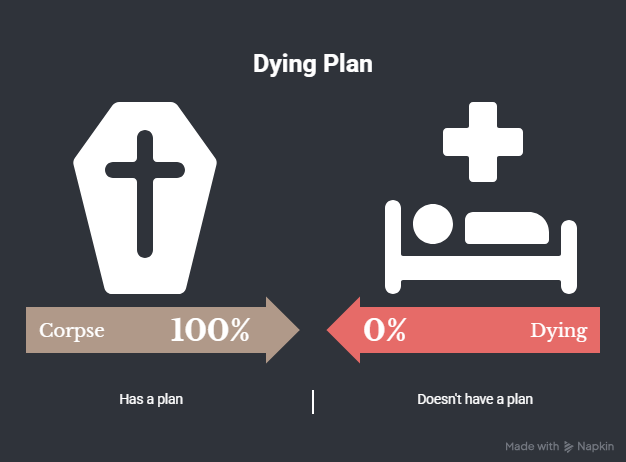
I've been thorough about the disposal and silent about the dying.
I am not afraid of being dead. I am afraid of hurting, and of being handled.
Those are two different fears, and I want to keep them separate. Being dead doesn't worry me at all. What worries me is the stretch of time before that, and what gets done to me in it. I have two cancers. Both of them travel with pain, and pain is the thing I want least.
So here is my number one wish, and I'm going to say it before anything else. I want a death without pain. Everything else on my list is negotiable. That one isn't.
The question I have been answering wrong
I went looking for how others think about this, and I found a woman on a message board who asked a very simple question. How do you plan to die? Not retirement. Not the will. The dying.
Then she had to come back into her own thread and correct everybody. She wrote that people kept answering about how they wanted their corpse handled. Cremation, caskets, ashes, a hole in the back forty. What she wanted to know about was the hours, days, and years before that.
She's right, and I was doing the same thing she was complaining about.
I have written about the house, the stuff, and the twenty thousand photographs. I have written about who has to do what after I'm gone. I've been thorough about the disposal and nearly silent about the event. My corpse has a plan. My dying doesn't.
That's the piece of it I want to take up here, and I'll warn you now that this is a selfish one. It isn't about my family. It's about what I want.
What I want
I want to be able to end things early if the pain gets past what I can carry. That would mean a terminal diagnosis and physician-assisted dying, and I have made my peace with that a long time ago. I think Suzanne has too.
I do not want the ICU. If the choice is an intensive care unit or dying, the answer is dying, and I'd like that understood by everyone who might be in the room. I have no interest in the medical industrial complex working on me. If the way out is to stop eating and drinking, then that's the way out. A couple of hard days, a coma, goodbye.
I'd like a party. Small. Not a funeral, not a memorial, a party — while I'm still here to be at it.
And I love telling stories. Suzanne has heard all of them a gazillion times. If people want to come sit down and hear them again, that would be a wonderful afternoon. Whether I have the strength for it is a real question. I suspect I'll have the mind. The body is the part I can't promise.
Then, if I got to write the ending myself, I would close my eyes after the party and not open them. I don't think that's on the menu. If it happens, I'll be very thankful.
A man in a chair
A month ago somebody wrote up her father's death in Colorado, and it's the most useful thing I read all week.
He was diagnosed with a brain tumor hours after finishing a round of golf, and he was dead seventeen days later by his own choice, under his state's law. What scared him wasn't dying. It was the specific way that disease takes you — aware, and unable to speak. He'd had a taste of it and swore he'd never do it again.
Her line that stopped me was almost an aside. She said he chose to die in his office, sitting up in his office chair, and that until then she hadn't known you could choose to die sitting up. She'd always pictured lying flat in a bed. She asked hospice about it, and they told her he could go sit out on the porch if he wanted. They'd set it up.
Now, I knew that was available. I'm not sure an office chair is my idea of a good exit, and I don't think that's what I'd pick. That isn't the point. The point is that a grown woman sitting inside her father's death didn't know the porch was on the table until she asked, and nobody had told her, because nobody tells anybody.
There's more like that in her account. He told exactly one person outside the house, his brother, the night before. He knew which of his two children could stay in the room and which one couldn't, and he cast it that way on purpose. He asked for hospice to be present, and he said plainly it wasn't for him — it was so his family wouldn't panic when his color changed.
That is a man running a room. He'd never done it before, and he had no manual.
The other one, and this is the one I keep thinking about
In the comments underneath, a woman described her eighty-eight-year-old mother, who chose to stop eating and drinking. She lasted seven days.
For the first three and a half of them, her daughter says, she held court. She sat in a chair. She received visitors from a list she'd made herself. She told stories. She had her daughter write checks while she watched, and she had a phrase for that — she wanted to give with warm hands rather than cold ones.
I've read that a dozen times. She had no training and no ceremony to borrow. She built one anyway, out of a chair, a list, and whatever days she had left. Nobody handed her that.
Except somebody did, once, and we lost it.
Where I went looking after that
There's a doctor at Columbia named Lydia who went back and dug up the Ars Moriendi — the art of dying. After the plague, the church put out handbooks on how to die. Not how to arrange the funeral. How to die. They were practical, widely copied, and used by ordinary people.
They paired the temptations of the dying with their answers. Despair gets met with hope. Arrogance gets met with humility. The idea underneath it was that dying is a skill, and skills get studied before you need them.
Dugdale's argument about what went wrong isn't that we stopped planning. It's that we kept the part about personal choice and threw away the part about the village. We made it a private matter, and then we put it in a building with linoleum.
And I want to be careful here, because the numbers don't say what I assumed they'd say. More Americans now die at home than in hospitals — that flipped back around 2017, for the first time in half a century. So we've already come home. We just came home to a house where nobody knows the words.
Here's what that actually looks like now. On a hospice message board, a woman who works as a death doula described what she does when a dying person is going to have a lot of visitors. She writes a sign. She prints it and tapes it up in the entryway. Wash your hands here. Twenty minutes is a good visit. She can hear you even when she's asleep. Don't react to how she looks — it upsets her. She knows she's dying and can't talk about it in detail anymore.
Read that and tell me the craft isn't gone. The manual has been replaced by a laminated sheet that the exhausted daughter writes herself, on the worst week of her life, because not one person walking through that door knows their part.
The thing I found that argues with all of this
I went looking for people describing a good death, expecting to find craft. I found the opposite, and it's been sitting with me ever since.
Ask a room of experienced people what a good death looks like, and they describe an ambush. One man's father died in his easy chair in front of the television, and the detail his son offered as the good part was that there wasn't even time to say I've got a pain. Another described a ninety-year-old who felt off, went in, and was gone in days. Another said the ideal was going suddenly, at a ripe old age, without harming anybody.
Somebody laid out the logic of it directly. A sudden death lets you skip the whole thing — the fear, the dread, the knowing.
So the dream death, for most people, is the one where the dying part gets deleted. No room. No list. No chair. No craft, because there's nothing left to practice.
I don't have a rebuttal for that. I'd take it too, honestly, if it were offered. I said above that I'd love to close my eyes after the party — that's the same wish as wearing a nicer suit. The difference is only that I don't expect to get it, and they might.
Knowing it's coming is either the worst thing about my situation or its only advantage. Most days I can't tell you which.
The thing almost nobody will say
There was one thing that came up over and over in these threads, always sideways, never straight.
People don't want to be seen.
A family wrote in, bewildered because their dying mother had refused every visitor, including the ones who'd cared for her for two years. The reason wasn't philosophy. She had a rash across her face, and she'd said she looked like a monster. Somebody else answered with the best sentence in the whole pile — that her own mother wanted no visitors either, because she was vain and it made her anxious, and that this was her death, and that was that.
Her death. Two words, and they settle it.
I want to say plainly that I don't share this one, and I'm not saying that to be brave. I don't care if people look at me. It's going to be what it is, and I've stopped negotiating with my own appearance.
More than that, I think there may be something in the room worth being present for. People who sit with the dying report that, near the end, the person starts talking to someone who isn't there. To people who died years ago. I don't know what that is. I'd like it to be what it looks like, and I think there's a decent chance it is, and I'm not going to pretend to be more certain than that.
But here's my honest position. If I do that, I'd rather my kids saw it than didn't. Not for me. It might be the single most useful thing I ever hand them, and I won't be in any condition to explain it.
That's the fork, and I don't think either road is wrong. Some of us want the door shut. Some of us think the door is the whole point. What I'd hate is for anybody to end up on the wrong side of it because they never said which one they wanted.
Who gets a vote
There's a sentence that shows up in every one of these conversations like a hymn. The funeral isn't for you. It's for the people left behind.
I found a woman who took that all the way. Her mother said she didn't want a funeral. Her mother died. The daughter held a funeral anyway, called it something softer, and reported it without a shred of apology — because it wasn't fair to the people who survived her mother to go without one.
That's my piece arguing back at me, and it deserves an answer. Here's mine, and it's a split.
The dying is mine. How and when and where, the drugs, the ICU, the room — that is not a family decision, and I'm not putting it to a vote. The afterward is theirs. The memorial, the service, the what-do-we-do-now, all of it belongs to Suzanne, my son, and my daughter. I don't want a funeral, and I've said so. If they decide they need one, that's their business, and I mean that.
What I don't want is for either half to be decided by strangers in a hallway at two in the morning. So we're going to do both while I'm alive.
Where I actually am with this
Writing this made me sad, and I didn't expect it to.
Not the pain part. Not the ICU part. I've turned those over so many times they've gone smooth. It was the sentence about leaving the world gently. That one caught me because it's a wonderful thought most people don't get, and I've been walking around assuming I would.
Then there's the thing I don't have an answer for at all.
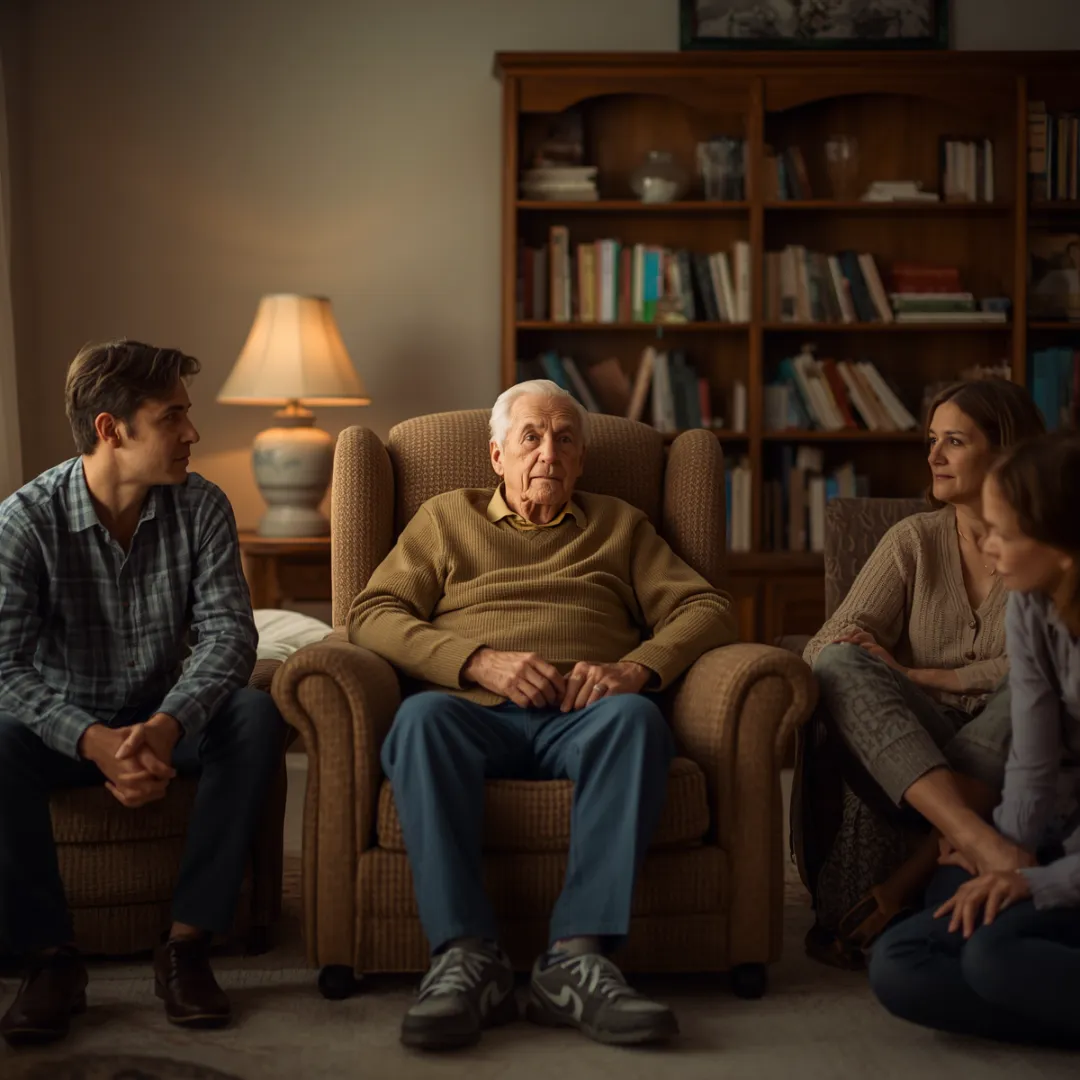
A cousin asked me a question a while back that I've not been able to put down. How am I going to handle myself as I get more infirm? Not how do I want to die. How do I intend to be, in the stretch before that, while I'm still here and less able?
I had nothing. Suzanne has nothing. We've started the conversation two or three times now, and every single time we end up in the same blank place and stop. It's the one part of this where I can't even find the vocabulary, and I notice that's exactly the part the old manual was written about.
And I'll tell you the thing I've been sitting on. My wife knows precisely how I want to die. We've been clear with each other for years. My children have never heard a word of it from me. They may have pieced it together — they're not stupid, and I'm not subtle. But I've never said it to them out loud.
I'm going to. My intention is Thanksgiving, and if not then, before the first of January. That's a real deadline, and I'm putting it in print so I can't quietly let it slide.
I have a decision rule, which is the closest thing to a plan I own. When I can't string together more good days than bad ones, it's time. That's it. That's the whole document.
What I don't have is the part in between — the sitting up, the list, the visitors, the room, the words. A woman I'll never meet built all of that at eighty-eight out of a chair and a piece of paper, and I'm not sure I could do it tomorrow.
Your turn
If you've been in the room with somebody who was doing this well, I want to hear what they did. Not the paperwork. The room. What did they know that the rest of us don't?
And if you're on my side of it — have you told anybody what you actually want? Not the cremation. The dying. Have you said it out loud to the people who'd have to hear it?
I read every comment. That's my favorite part of this.
Hey, this is Josh. You're on the Long Strange Trip. I'm glad you're here.

Facebook
LinkedIn
Youtube