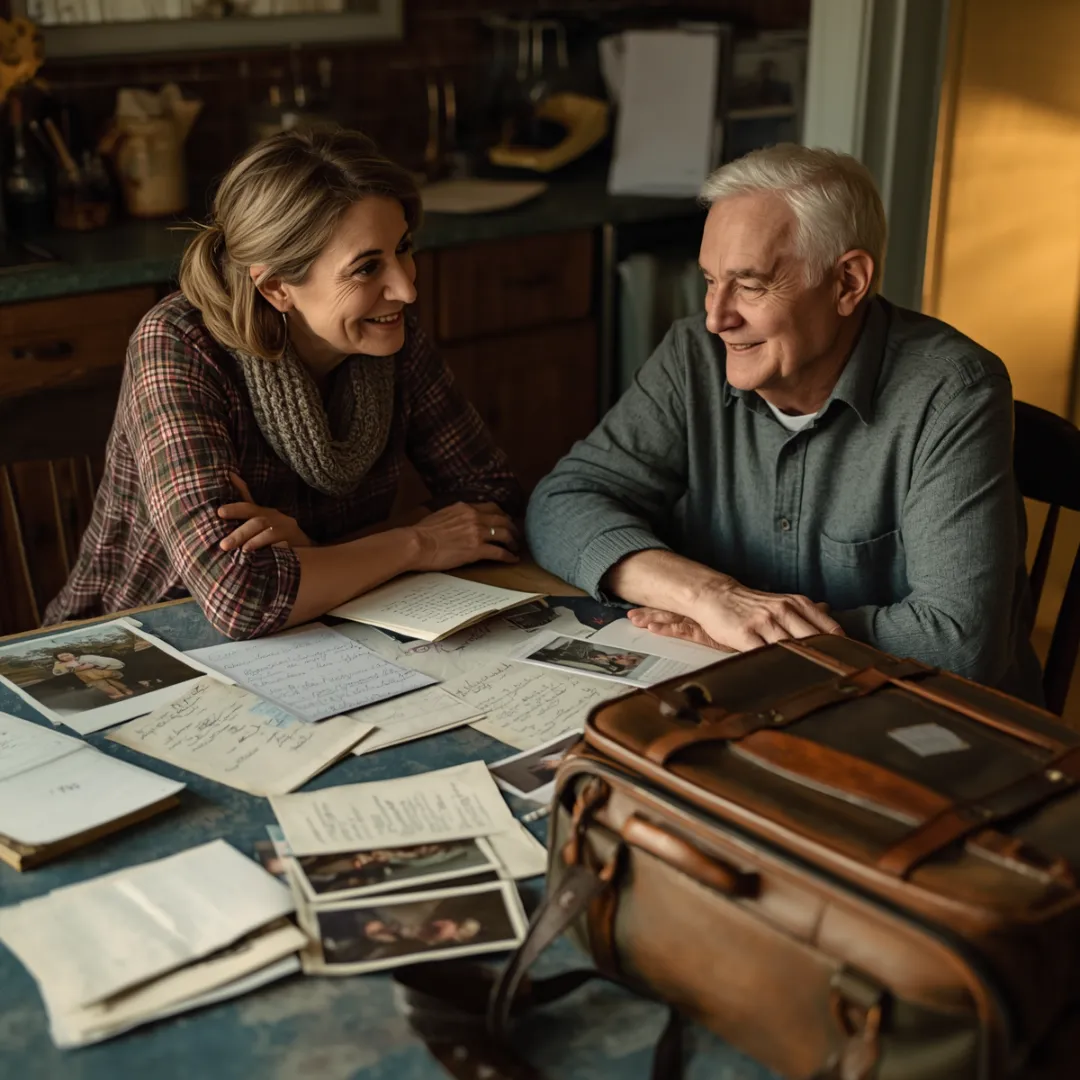
Death Pulled up a Chair
What a death doula taught me about packing for the move
I want to tell you about a conversation I had the other day, because I haven’t been able to put it out of my head.
I’m 73, and I’m navigating a dual cancer diagnosis. So when I talk about death on my podcast, I’m not a journalist holding it at arm’s length. I’m a guy who can feel the question moving closer. A fellow traveler, not an expert, figuring this out in real time — same as you.
My own conversation with death keeps circling one question: how do you make a good death? Not how do you dodge it — none of us gets that option. How do you meet it well, on your own terms, with as little fear and as much grace as you can manage? And can a death doula help you do that?
I’ve started to think this is the most interesting corner of the whole Long Strange Trip investigation. There’s so much going on around death now — options we never knew we had a few years ago. The map is being redrawn while most of us aren’t looking. I want to know what’s on it.
My guest was Jeffrey Deckman. I’ll confess I blanked on his last name on the air and made him say it twice. My memory isn’t what it used to be, and I’ve made my peace with that, too. Jeffrey is a death doula. And my first honest thought was the one you might be having: I don’t actually know what that is.
Most of us don’t. So let me walk you through what I learned.
Midwives for the other end of the trip
You know what a birth doula does. They show up when a life is arriving and hold the space — keeping the mother company, staying calm, making the room feel human instead of clinical. They don’t deliver the baby. They hold everything around it.
A death doula does the same thing at the other end of the trip. Midwives for the leaving. (Jeffrey says “end-of-life doula” works too — the gentler name is there on purpose.)
Here’s the part that grabbed me: they show up with no agenda. No medical bag, no treatments, no chart, no outcome to force. What they do is listen. Jeffrey kept returning to one word — container. A doula creates a container, a safe and unhurried space where a dying person can say what they need to, ask what they need to, and have their own experience without anyone barging in to fix it.
Sometimes that relationship lasts months. Sometimes weeks. Sometimes the doula arrives right at the end and it’s a matter of days. And sometimes it’s a two-minute hello that cracks open into something much bigger.
I asked what he calls the people he works with — patients? clients? He landed on something close to friends. That tells you most of what you need to know about the work.
Where the doula fits, and where the system doesn’t
Jeffrey does most of his work at a hospice house outside Nashville called Alive. Thirty rooms, thirty people, most about two weeks from the end. He goes on Thursday evenings and sits with whoever’s awake and willing. He calls it sacred the moment you walk in. I believe him.
He drew a line I hadn’t understood. Hospice, wonderful as it is, still lives inside the medical structure — covered by Medicaid, with things it can and can’t do. A doula lives outside that entirely. They’ll run an errand. They’ll sit with the dying person so an exhausted caregiver can shower, eat, or go cry in the car for ten minutes. No medications, no treatments. Just the human level. They fill the gaps that the system was never built to hold.
And then Jeffrey said something I’ve been chewing on ever since:
Death doesn’t hurt.
The diseases hurt. The treatments hurt — I can vouch for that personally. All the pain we associate with dying comes from what happens beforehand. The actual experience of death, he says, is deeply peaceful. We’ve just been trained to believe the opposite.
The medical industrial complex
And we have been trained. I call it the medical-industrial complex on purpose because it isn’t so different from the military one. These institutions exist, in part, to keep themselves running. And the last six months of a life generate enormous revenue — often with almost no benefit to the person living through them. In the final stages of a cancer, the system’s impulse is another procedure, another treatment, fight a little harder, instead of backing up and letting a natural process do what it’s always done.
I want to be careful here, like Jeffrey was. This isn’t about demonizing doctors and nurses — most are good, devoted people. But they were trained inside a paradigm that treats death as a failure. A defeat to avoid at all costs. That runs counter to thousands of years of understanding of dying as a natural stage of the trip, not a system error.
The part that really stops me: that paradigm assumes a day added to a life always beats a day of quality in it. It doesn’t. I’ve watched it not be true. Jeffrey watched his own father and brother suffer through it.
I try to stay neutral on almost everything. Not on this. If your last days are spent under fluorescent lights, surrounded by beeping monitors and overworked staff straining to save a life that’s ready to complete its arc, you already carry PTSD just from being there. There are gentler ways to make this passage. Too many families never learn they exist until it’s too late to choose them.
How a man becomes a death doula
I was curious how someone ends up doing this — it’s not on the career-day poster. Jeffrey’s road is its own teaching.
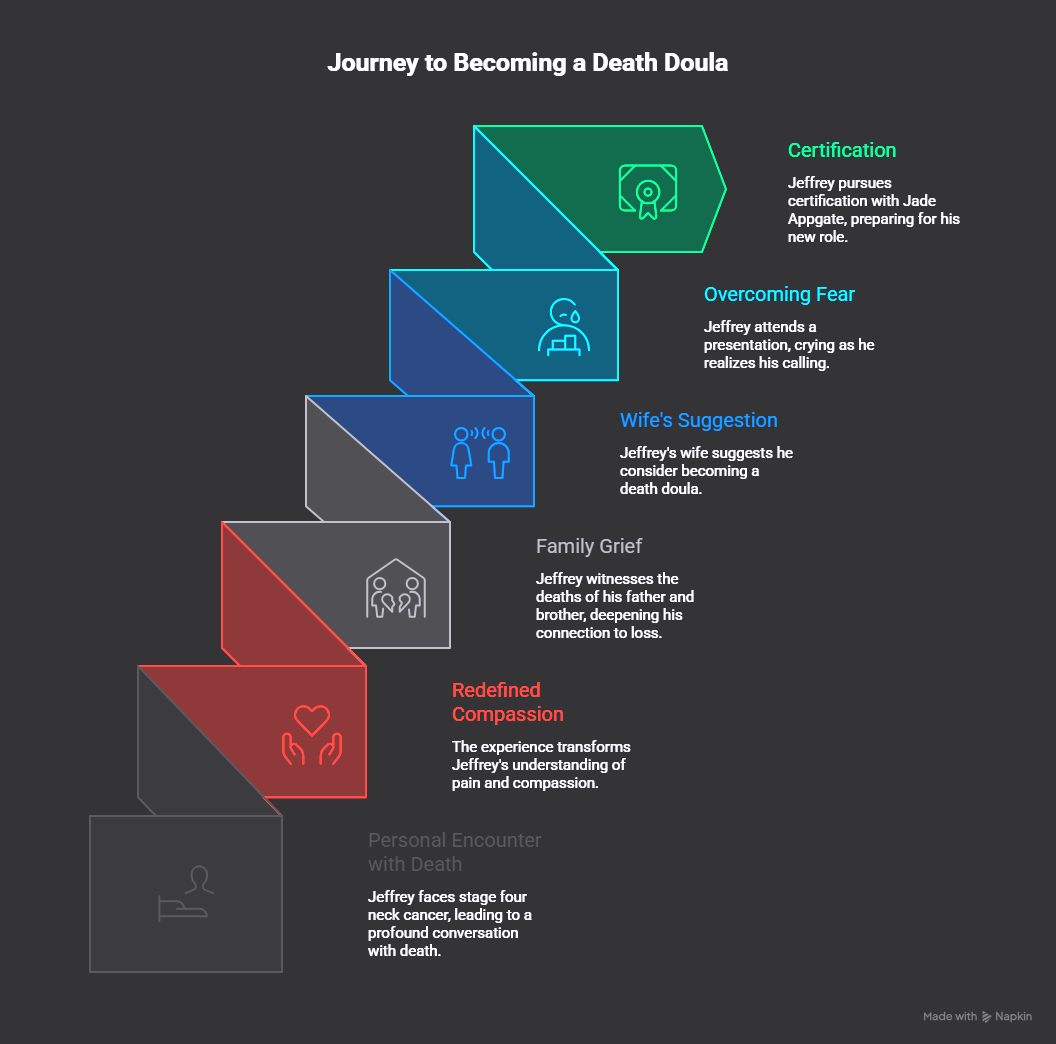
He never expected it. He spent decades in spiritual and consciousness work. Then, ten years ago this month, death pulled up a chair: stage four neck cancer, a small cell carcinoma that started at the back of his tongue and moved into a lymph node. He spent that year in treatment and the long climb back. That’s when he had his own conversation with death. He described it perfectly — death flipped a chair around, sat down, and said, okay, we’re going to talk now, whether you want to or not.
It changed how he saw everything. It taught him what chronic pain really is and cracked his definition of compassion wide open.
Then life kept handing him the curriculum. In 2020 he was at his father’s side when he died — they were close. A year ago this month, his younger brother died of an ALS-like disease. The grief was still fresh in his voice.
It was his wife who said the words first: have you ever thought about being a doula? His honest answer was no — he didn’t know what one was, and once she explained, it scared him. Too intimate. In the room with strangers at their rawest moment? No, thank you.
But here’s his line I keep turning over: I try to stay open to things that scare me. So he went to a presentation by a woman who’d done this for thirty years. Sitting there, he cried. Twice. Not at any one story, but because something in him understood he was being asked to find the strength to do exactly this. That was the beginning.
He’s now finishing a certification with Jade Appgate, near Nashville, whom he calls the best of the best. Her organization is Farewell — as in goodbye — at farewelleducation.com. I’m passing that along for anyone who felt something catch in their chest reading this, the way Jeffrey did in that room.
Packing for the move
I brought Jeffrey the one worry I couldn’t put down.
Vermont — my state — has a medical aid-in-dying law, Act 39. It’s been on the books since 2013, and in 2023, Vermont became the first state in the country to drop the residency requirement. I’m glad it exists, and I’ve thought hard about what that option would mean for me.
But I have this stubborn belief in what I call the liminal space — the stretch between being fully alive and fully gone, where dying people start having conversations with folks who aren’t in the room, where something seems to be happening the rest of us can’t see. I think it’s sacred. I can’t prove a word of it. My fear about aid in dying is simple: when death comes that fast and gentle, do you skip the liminal space? Do you lose it?
I’ve asked a lot of people in this world. Nobody had an answer that stuck. Jeffrey tried.
He said the only difference is how much time you spend packing before you move. You’re moving either way. Whether you take three weeks or three minutes, the moment you arrive you’re met. Embraced. Shepherded by your guides, angels, ancestors — whatever name you give them. Even someone killed instantly, he said, doesn’t wander around lost. The packing time differs. The welcome doesn’t.
He went further: the experience waiting on the other side is so loving, so far beyond anything we can imagine here, that the only real variable is how much packing time you get. That’s the whole difference.
I’ll be honest — it didn’t fully satisfy me. It’s a beautiful answer, and I’ve turned it over many times, but the knot in my chest is still there. I’m not done with this one. There’s a community doing deep regression hypnosis — they call the work “The Life Between Lives” — and I suspect that’s my next doorway. If that space is real, and I believe in my bones it is, I want to learn everything I can before it’s my turn to walk through. That’s the seeker in me. I can’t help it, and I don’t want to.
The pastel people
He told me one more story, and it’s the one I most want to hand you.
Three weeks before we talked, on his rounds at Alive, Jeffrey met a 72-year-old man. Close enough to his age, and to mine, that it sat with both of us. The man had an edge — spicy, a former rascal glad he’d grown out of it. But the longer they talked, the more he opened.
He told Jeffrey that three weeks earlier he’d had a heart attack — a near-death experience right there in the hospital bed. The only way he could describe it: pastel people showed up. The kindest, softest beings he’d ever encountered. All he felt was love, and he knew exactly what they’d come for.
And then — the part that made both of us chuckle, even in something so tender — they almost apologized. We came too early. You’re not coming with us yet. But we’ll be back. And they vanished.
Jeffrey asked if it changed his thinking about death. The man had always figured energy doesn’t disappear, it transforms, so he’d go on somehow. But this was different — so intimate and real that he now knew where he was going. And here’s what undid me: he said he was actually a little excited to get there, because he’d never once felt that safe.
Jeffrey went back the next Thursday. The man had passed in between. Jeffrey, who’d felt a real friendship spark in that one conversation, was caught off guard by how sad it made him — and a little honored to have been one of the last people that man let all the way in.
Just last night, he told me, he sat beside a woman whose husband was dying of Parkinson’s at 67. The moment opened to hand her that same story — the pastel people, the love, we’ll be back — and he watched it bring her comfort. First-person comfort, passed from one frightened heart to another. That’s the whole job.
Why I’m telling you all of this
I’ll lay my cards on the table. I’ve had out-of-body experiences I have no tidy explanation for, and long ago stopped needing one. My first happened at a new age seminar, of all places. One moment I was in the room; the next I was floating clear outside my body, high above the earth, arms wrapped all the way around the planet. What came with it wasn’t fear — it was a bone-deep, unarguable knowing that we are all one. Not a thought I had. A fact I touched. I came back down a different man, and that knowing has never fully left me.
I’ve also listened to a lot of folks who’ve had near-death experiences. The stories are never identical. But they rhyme. There’s a peace that keeps surfacing in the retelling, like a melody you can’t name but somehow already know.
I’ll be honest about my limits. I don’t have a tidy theory about what’s on the other side, and I don’t trust anyone who says they do. Jeffrey pointed me to an old book, Journey of Souls, by a clinical psychologist who used hypnotic regression and found patients describing the space between lives. The accounts rhyme there too. He even noticed that what people expect — their religion, their picture of the afterlife — seems to shape that first moment of crossing, before something deeper takes over. I hold all of it loosely.
What I don’t hold loosely is this: I’ve come to suspect we’ve been handed the wrong story about the ending. We’re told it’s only terror, only loss, only fluorescent light and defeat. But the people who actually sit with the dying, week after week, keep telling a different story — one with far more grace in it than we were led to expect.
If you’re carrying fear about this, for yourself or someone you love, I’ll offer you what Jeffrey offered me. Maybe death isn’t the catastrophe we’ve spent our lives bracing for. Maybe it’s just a move. And maybe, when the day comes, there’s someone soft and patient waiting to help us carry the boxes.
I’m still figuring this out, same as you. But I’m a little less afraid than I was last week, and at 73, with my own conversation with death well underway, I’ll take every ounce of that I can get.
Now I want to hear from you
This is exactly the kind of thing we’re meant to figure out together, so I’ll ask you to do more than read and nod.
Have you ever had an out-of-body experience, or a near-death one? What was it like? Every story I collect makes the melody a little clearer. And the bigger one: have you thought about what a good death would look like for you — really sat with it — and done anything about it? A conversation with someone you love? A plan? A call you keep meaning to make?
Hit reply, or leave a comment. I read every one, and these are the conversations I most want to be having right now.
Keep asking the hard questions. Keep being honest about what’s difficult. And remember — we’re all just trying to figure this out together.
I’ll see you next time on the Long Strange Trip.
— Josh
This essay grew out of my conversation with end-of-life doula Jeffrey Deckman on the Long Strange Trip podcast. If you’d like to reach Jeffrey directly — to learn what a death doula does, or to explore working with one — you can email him at [email protected]. And if you or someone you love is wrestling with end-of-life questions, please know that’s a heavy thing to carry alone. A hospice team, a death doula, or even one trusted person in your corner can make a world of difference.

Facebook
LinkedIn
Youtube