The Things I Never Said to My Father
Showing up isn't owed. Saying nothing isn't a crime. But it helps to know which one you're doing.
Showing up for someone who harmed you isn't owed. And choosing not to isn't cruelty. I need to say that first, because almost nobody says it out loud. The person standing in the hospital hallway hears the opposite from every direction.
You'll regret it. He's still your father. Let bygones be bygones. Those lines come fast, and they come from people who mean well. Most of them never lived in your house.
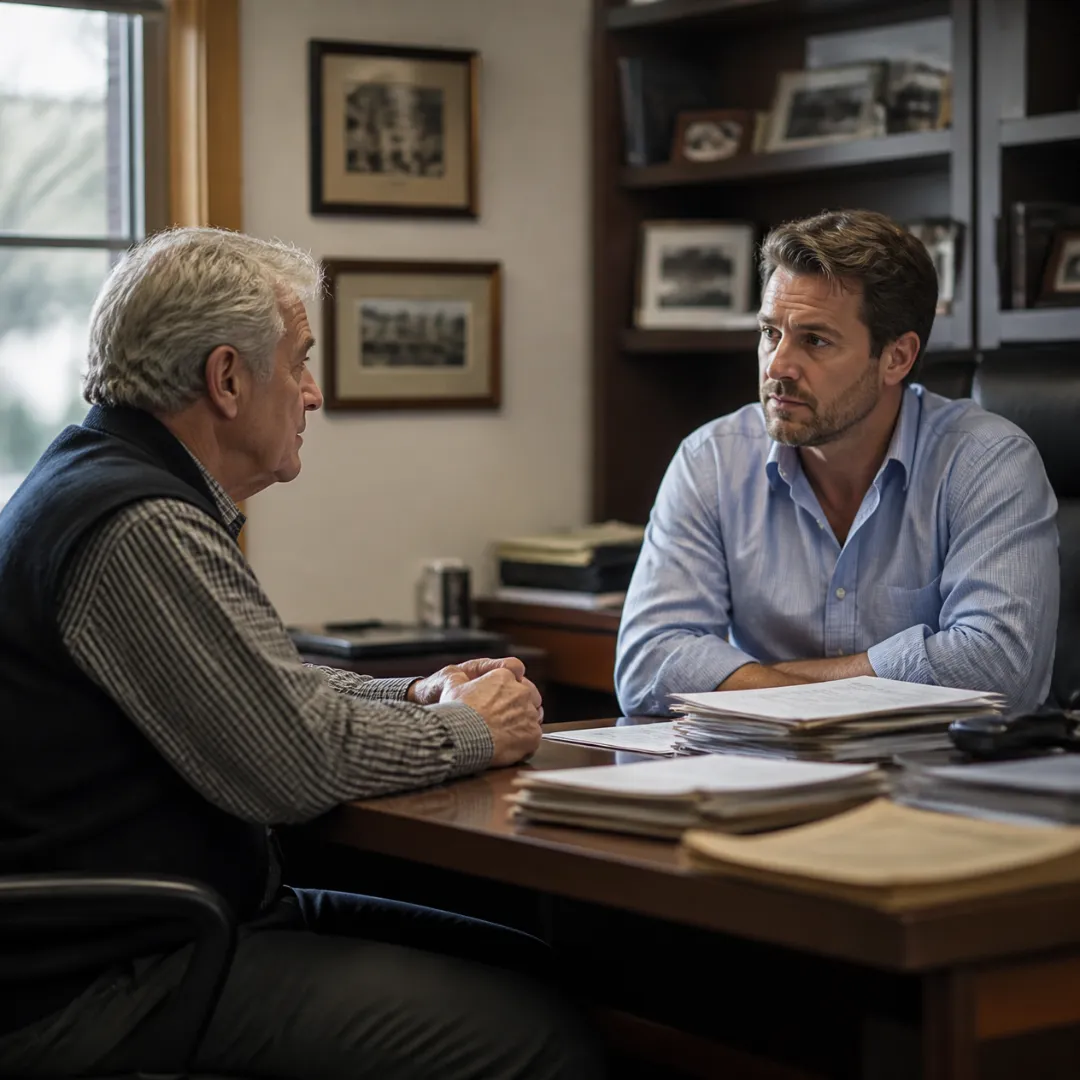
I'm 74 now, with two cancers of my own. My father has been gone for years. This week I learned I'm not done thinking about how he died. Or about how I behaved while he did.
A morning with strangers
This week I spent a long morning reading strangers. Caregiver forums. Grief groups. Message boards where people post at two in the morning. Nobody else is awake to hear them.
They were all asking a version of the same question. My parent hurt me. My parent is dying. What do I owe?
What struck me was how fast the answers came. And how sure everyone was.
One chorus said walk away. A woman on Mumsnet said her father raged at her in a hospital ward. He did it in front of the nurses. All her childhood terror came flooding back. Within minutes, a dozen strangers told her to step back. Let social services take over, they said. You owe them nothing.
A second chorus said stay quiet. On a caregiving forum, a daughter asked about her father in hospice. Could she finally raise the old hurts? Nearly every reply said no. Thank him. Bring up the happy memories. Don't unburden yourself on a dying man.
Here's the thing. Both choruses tell the hurt child what to do. Neither one asks what it costs.
What keeps them up
Underneath the advice, I kept hearing the same fears. They're worth naming, because most people never say them out loud.
The first is simple. Am I a bad person? Posts started with "please don't judge me." Grown adults were asking strangers whether they were allowed to feel what they felt.
The second surprised me. My hurt wasn't bad enough to count. One woman opened by saying her dad never abused her. He was just stubborn. Another called her father "otherwise" a good dad. People measured their wounds against the violent stories. Then they decided theirs didn't qualify.
The third fear pulls in two directions at once. If I don't go, I'll regret it forever. If I do go, he'll hurt me one last time. One man skipped visits to his dying father for years. After he died, a cruel letter turned up in the will. Years later, it still gets to him.
I kept wondering which of those fears was mine.
More of us than you'd think
This isn't a rare problem. Katie Engelhart wrote about it this summer in The New York Times Magazine. She leaned on research by Jooyoung Kong, who studied about a thousand adults caring for aging parents. Nearly one in five reported childhood abuse by a parent.
Engelhart's central figure, Carole, cares for her father anyway. She drives him to appointments and manages his medications. She steadies his arm when he gets out of the car. But she won't hug him.
She does it, she says, so she can live with herself after he's dead.
I understood Carole. But I didn't quite fit her story either. I didn't fit any of them. It took me most of that morning to figure out why.
Glens Falls to Burlington
My father's dying took about eight or nine years. It was a slow slide, not a sudden fall. He left his house. We moved him into assisted living in Glens Falls, New York. That didn't work out, so we moved him north to Burlington, Vermont.
A few days before he died, he fell and broke his hip. From the hospital, that was the end.
I was in my late sixties. I'd love to tell you I was at the center of all that. I wasn't. My sister carried most of it. She set up his apartments and cleared out the house. She made sure he was comfortable. She was a trooper.
I handled selling the house. I visited. That was about it.
There's a voice that got me through those years. You may have one too.
The old me: It's done. What's next?
Move him. Sell the house. Sign the papers. Next. That voice got every job done. It never once asked how I felt about the man in the bed. And I never asked it to.
What we talked about
People ask whether I wanted to say something to him at the end. The honest answer embarrasses me a little. It never crossed my mind.
I don't remember a single thing we talked about in those years. Not one conversation worth writing down. We talked about nothing, and we did it carefully.
If I had thought about it, I know what I'd have feared. Any real talk would have turned unfriendly fast. With my father, it usually did. So I probably would have said nothing anyway. I didn't want more conflict.
But I didn't think about it. That's the part I keep turning over. I didn't choose silence. I just did it.
His hands
Near the end, after the hip, his hands started moving on their own. They waved in the air, reaching. He was talking to somebody, too. It was mostly gibberish, but he was clearly talking to someone. I've seen this before with people near the end, and every time I find it fascinating.
I sat next to the bed and watched. He had plenty to say to whoever he was seeing. I didn't have much to say to him.
A picture of my father
Let me paint you a picture of my father. Not the hard parts. Those I'm keeping.
He was a narcissist. I don't say that lightly, and I don't say it to be cruel. The world revolved around him. When it didn't, he got unhappy, and everyone in the house knew it.
My mother told me a story once. She was doing community theater, and he didn't like her being away. She pointed out that he was always asleep when she was home anyway. His answer: "I don't care. Just watch me sleep." That was my father, in five words.
His love felt conditional to me. I played on the tennis team. A great match brought lots of praise. A bad match brought the opposite. Basketball was the same. Do it his way and win, and you were loved. Otherwise, you weren't.
If your father wasn't like that, I'm glad for you. Truly. That's where unconditional love comes from, and it's a gift.
A means to an end
Here's a strange thing about my father and me. We were both in business, and we didn't share it at all.
For him, business was a means to an end. He grew up in the Depression, even though his family wasn't hit hard. What he wanted was financial security. And to be fair, he got it. The means worked.
For me, business was a game I loved. I liked the strategy and the people and the puzzle. When I sold the food service company, I don't think it touched him at all.
Two men in the same line of work, speaking different languages. I wonder now how much of our silence started there.
Don't tell jokes
After my first public talk, at 24, my father came up to me. "Don't tell jokes," he said. "You're not funny."
I tell that story in speeches now. It gets a good laugh. And here's the funny part: he was right. I'm a terrible joke teller. I'm funny when I tell stories about my own mistakes. Jokes, not so much.
What interests me now is what happened in that moment. His words didn't register. I walked off that stage feeling great. I thought the talk went well. I'd stopped listening the second he started.
That was my move with him for most of my life. Sometimes I fought back before he got three words out. Other times I closed the door and heard nothing. Maybe shutting off and shutting up were the same move.
By the time he was dying, I'd had sixty years of practice at the second one.
The apology
Before he moved into assisted living, my father apologized to me. More than once, actually.
The words were right. The details were wrong. In fact, there were almost no details. It was a blanket sorry, and I never took it seriously.
A commenter on Ask MetaFilter described a father like mine. He had pushed the "sorry button," she wrote. Then he couldn't understand why anyone was still upset.
This may not be everyone's belief, but it's mine. An apology needs specifics. Specific actions. Specific moments. Without them, the other person has no idea what you're sorry for. Maybe you don't either.
I learned that from him, in reverse. A while back, I wrote a letter to my own kids. I named things I'd done that made their growing up harder. I kept it to what I did, not what they did. My father's apology taught me what that letter needed.
Looking for an answer
So was my silence a mistake? I went looking for an answer. The research didn't hand me a clean one.
Grief researchers call it "unfinished business." A team led by Jason Holland and Robert Neimeyer found that unresolved conflict raises the risk of long, stuck grief. Neil Chethik heard the same thing from the sons he interviewed for FatherLoss. The ones still angry at their dads had the hardest time.
That should worry me. Here's what surprised me. The same researchers found a catch. Having unfinished business mattered less than how much it still bothered you. And Kong found a wrinkle of her own. For caregivers mistreated as kids, coping through their emotions went with more depression, not less.
So maybe one foot in front of the other protected me. Maybe "It's done, what's next" was the right tool for that job. Or maybe it just postponed the bill.
I honestly don't know. Those findings sit side by side on my desk, pointing in different directions.
How I handle conflict
Here's what I've figured out about myself. I could have taken him on. I could have ignored him completely. Instead, I went someplace in the middle. Looking at the rest of my life, that's how I handle most conflict. I don't always avoid it consciously. I just drift toward neutral.
Would I do it the same way again? Yes. And I want to be careful with that yes. These days I'm trying hard not to speak in absolutes. When I say it was right, I mean right for me. It might be dead wrong for you.
I'm not even sure neutral was right. It's just what I did.
The sentence I didn't say
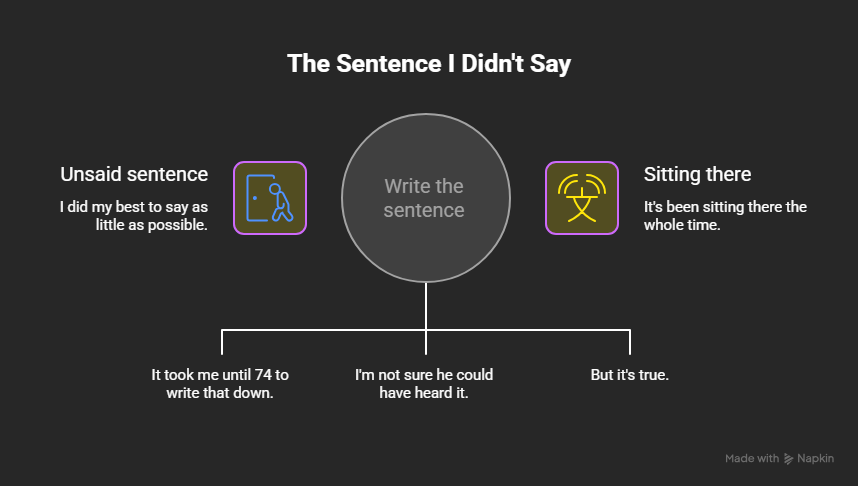
I do know what my one true sentence would have been:
"I'm sorry we never really had a relationship that was trusting and close. I was always scared anything I said would set you off. So I did my best to say as little as possible."
It took me until 74 to write that down. I'm not sure he could have heard it. I'm not sure I could have said it without starting a fight.
But it's true. And it's been sitting there the whole time.
If you're in that hallway
So what can I hold for you? Not permission. I'll be honest about that. Back then, someone could have told me to say what I felt. I'd have turned them down. I didn't see the point. Maybe you don't either, and that's allowed.
What I'd hold is this. The difference isn't between speaking and staying silent. It's between doing it on purpose and doing it in your sleep.
I did it with my eyes closed, and I'm still sorting it out years later. I suspect eyes open would have left me carrying less. Whatever I'd decided to say. Even if what I'd decided was nothing.
And one MetaFilter commenter refused to make any of this easy. Old people need care, she wrote, good people or not. Staying away can make someone's death harder. You should look at that honestly. Then she said it's still okay if you can't. That was the most honest thing I read all week.
Who showed up
There's one more piece. It isn't about my father. My sister had a completely different relationship with him. She rarely got the brunt of his temper. Maybe that made it easier for her to show up. Either way, she showed up for years. I showed up for the paperwork.
I've never asked her why she didn't ask me for more. I've never asked whether she resented it.
I'd like to. I haven't. I'm not sure what I'm waiting for.
Have you sat beside someone who hurt you while they were dying? Did you say the thing, or keep it neutral? Did it even feel like a choice? I'd love to hear from you in the comments.
Hey, this is Josh. You're on the Long Strange Trip. I'm glad you're here.

Facebook
LinkedIn
Youtube