
Mindset or Action? You're Asking the Wrong Question.
Commit First. The Rest Is Noticing.
The question I keep getting wrong: is change a matter of mindset, or action? Turns out I've been asking it like there's one answer.
My favorite poem isn’t really a poem. It’s a paragraph a Scottish mountaineer wrote in 1951, and it gets me every single time.
“Concerning all acts of initiative or creation, there is one elementary truth — that the moment one definitely commits oneself, then Providence moves too. A whole stream of events issues from the decision, raising in one’s favor all manner of incidents and meetings and material assistance which no man would have believed would have come his way.”
That’s W.H. Murray, from The Scottish Himalayan Expedition. And here’s a small thing I love about that quote: half the internet attributes the famous line that follows it — “Whatever you can do or dream you can, begin it” — to Goethe. Murray credited Goethe too. The scholars say it’s actually a loose English paraphrase of Goethe, cleaned up by a translator named John Anster. So the most-quoted lines about commitment are themselves a little bit misattributed, passed hand to hand for seventy years by people who were too moved to check the footnote.
I find that oddly perfect. The idea is true even when the sourcing is messy.
Paulo Coelho said his version of it in The Alchemist: “When you want something, all the universe conspires in helping you to achieve it.”
Now, let me be careful here, because this is exactly the place where this kind of idea goes off the rails. Murray isn’t saying you think a thing and it appears. Coelho isn’t saying the universe is a vending machine and your wishes are quarters. That’s the watered-down, refrigerator-magnet version, and it’s garbage.
Here’s what I think they’re actually saying. The moment you genuinely commit — not hope, not intend, commit — something changes in how the world arranges itself around you. Doors you didn’t know existed start to open. People show up. Help you couldn’t have predicted finds its way to you.
That’s the part worth investigating. Not the magic. The commitment.
The Question Underneath the Question
So commitment is the starting gun. Fine. But it raised a question for me that I’ve been chewing on for years, and I still don’t have it fully solved.
When you want to actually change something in your life — really change it — where do you start? With your mindset, or with your action?
This is one of my favorite conundrums, and I file it right next to chicken-and-egg. You hear both answers preached with total confidence. One camp says it’s all mindset — fix how you think and the behavior follows. The other camp says forget how you feel, just take the action and let your head catch up. Fake it till you make it. Motion creates emotion.
And here’s the thing. They’re both right. And they’re both wrong. Because the honest answer, the one nobody wants to put on a poster, is: it depends.
I’ve come to believe the mindset-versus-action question is genuinely situational. Sometimes you have to change your head first. Sometimes you have to move your feet first. The hard part — the part I’m still working out — is knowing which is which while you’re standing in the middle of it.
Let me give you the two stories that taught me this. They land in opposite places, and that’s the whole point.
Story One: When the Head Had to Move First
For a long stretch of my life, I was not a responsible person.
I don’t mean I didn’t pay my bills. I mean that when something went wrong, my first move — automatic, reflexive, fast — was to find the person or the circumstance to blame. The market. The employee. The partner. The economy. There was always a reason that lived outside of me, and I was very good at finding it.
The turn came at a seminar. The leader put up a simple drawing: a horizontal line. Above the line he wrote one word — responsibility. Below the line he wrote two phrases — lay blame and justify.
And I sat there and felt the floor tilt a little. Because I knew, with total clarity, exactly which side of that line I lived on. I’d built a whole career below the line and called it being realistic.
That was a mindset moment. There was no action I could have taken that morning to fix it. I couldn’t do my way into being responsible. The first step was seeing it. Recognizing, in real time, that the thing I’d been calling clear-eyed was actually me dodging.
And I get it — that sounds like the easy part. Have the insight, feel the floor tilt, walk out a changed man.
Spoiler alert: it was not the easy part. It was not easy at all.
What I assumed would take a few weeks of willpower took me years. Because seeing the line once doesn’t move you above it. The work was noticing — over and over, in the actual moment — every time I started to slide below the line again. Catching myself mid-sentence reaching for the blame. Catching the justification before it left my mouth. Then doing the harder thing instead.
I spent the first several months of that trying to white-knuckle it. Brute force. Just decide to be responsible and clamp down. That barely moved the needle. What actually worked wasn’t force. It was attention. Noticing first, changing second, as fast as I could manage. The mindset had to lead. The action had nowhere to stand until it did.
Hold that word — noticing. It’s going to matter.
Story Two: When the Feet Had to Move First
Now the other direction. And this one I’d rather not have learned the way I learned it.
A dual cancer diagnosis at seventy-three. Let me not dress that up. The prognosis isn’t good. I do the math some nights and I doubt I’ll see eighty. That’s not me being dramatic. That’s just the number, sitting there on the nightstand, not going anywhere.
When that lands on you, the mindset gurus can pack up and go home. There’s no reframe for it. No empowering story. No morning affirmation that touches what’s actually happening inside your body. I’d love to tell you I found some serene acceptance, some warrior mentality. I didn’t. I found pain.
Real pain. The kind that takes up the whole room. The kind where there is no “you” left over to have an attitude, because every bit of you is busy just getting through the next hour.
What there was, was a schedule. Take this drug at this time. Show up here on this day. Endure this, recover from that, then do it again. And again.
I couldn’t think my way through any of it. There was nothing to think with. Mindset wasn’t on the back burner — mindset had left the building. The only thing in front of me was the next thing on the list. Take the drugs. Make the appointment. Get in the car. Get through today so there’s a tomorrow.
That was the whole strategy. Which isn’t a strategy at all. It’s just motion. Doing the next prescribed thing because it was the next prescribed thing, and because stopping wasn’t on the menu.
Some nights I’d lie there scared in a way I don’t have good words for, and the only thing that quieted it was the smallest, dumbest piece of the routine — the pill at 9, the water, the alarm set for the morning blood draw. Tiny actions. They didn’t fix the fear. They just gave my hands something honest to do until the sun came up.
And here’s what gets me, looking back. It’s working. Not because I had the right head about it. I didn’t have a head about it. I had a calendar and a body that hurt and a stubborn refusal to skip the next appointment. The action carried me through a stretch where mindset had absolutely nothing — nothing — to offer.
If you’d handed me a workbook on the power of positive thinking during chemo, I’d have found a use for it, and it wouldn’t have involved reading. Enough of the pity pills, though — that’s not where this is going.
Action led. It had to. There was no mindset left to lead with.
The Chicken and the Egg
So look at what I’ve got. Two changes. Two opposite answers.
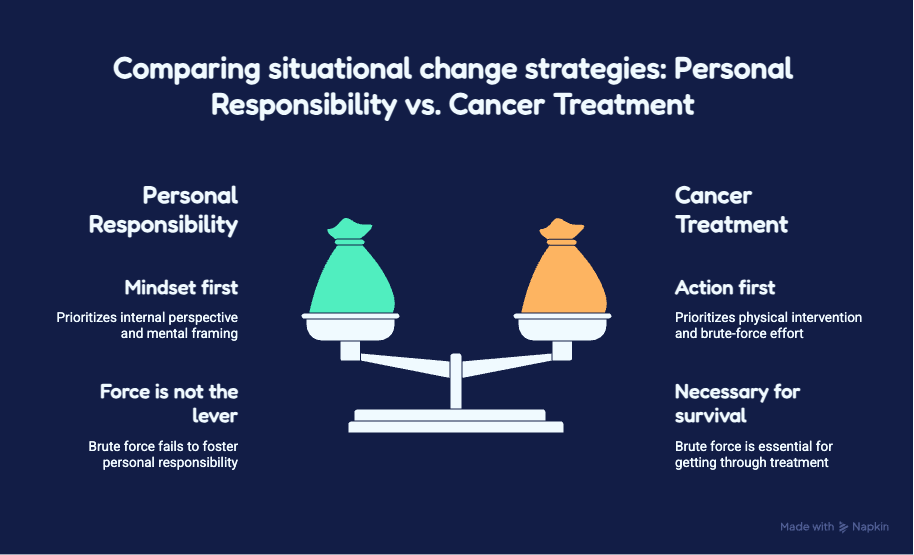
Personal responsibility: mindset first. Cancer: action first.
Same guy. Different moments. Completely different tools. And I couldn’t have swapped them — brute-force action wouldn’t have made me responsible, and there was no mindset on earth that was getting me through treatment.
That’s the chicken-and-egg. It’s not that one of these is the real answer and the other is the exception. It’s that the right starting point depends entirely on the situation you’re actually in. And most of the advice you’ll get insists on one or the other as a universal law, which tells me the person giving it has only lived through one kind of change.
I’ve lived through both. And I still get it wrong in the moment all the time. I default to brute force — just try harder, just clamp down — when brute force is exactly the wrong tool. I wasted months that way with the responsibility thing before I figured out that force wasn’t the lever.
So if it’s situational, the real question becomes: is there anything underneath that travels with you from situation to situation? Anything that helps you read which tool the moment is asking for?
I think there is. And I think I almost missed it because it was hiding in plain sight in both stories.
The Thing Hiding in Both Stories
Go back to the responsibility story. What actually changed me wasn’t the seminar. It was the years of noticing — catching myself sliding below the line, in real time, before the blame finished forming.
Now take a habit I’m still fighting today: I speak in absolutes.
I’ll say something, and the way it comes out of my mouth, it sounds like the God’s honest truth. Always. Never. Everybody. Nobody. That’s just how it is. And I know — I know — it’s not actually absolute. The problem is the person across from me doesn’t hear my private asterisk. They hear a man stating a fact. So my casual overstatement lands on them as gospel, and now I’ve put something into the world that isn’t even true.
How do I change that? Same answer. I have to notice. I have to pay closer attention to what’s actually coming out of my mouth, catch the absolute as it forms, and walk it back to something honest. Always becomes often. Nobody becomes not many people I know. It’s small. It’s constant. And it’s the same muscle as the responsibility work.
Here’s what I’ve learned, and it took me embarrassingly long to see it. Both of those changes — responsibility and absolutes — start with the exact same move. Noticing. Catching the thing in flight. And I file noticing squarely under mindset, even though it doesn’t feel like the dramatic mindset-shift the gurus sell. It’s not a new belief system. It’s not a reframe. It’s just paying attention to what you’re doing while you’re doing it.
That’s the bridge.
Mindset versus action is a real choice, and it’s situational. But noticing is what told me which one the moment needs. Noticing is how you catch yourself reaching for brute force when force won’t work. Noticing is how you realize, in the cancer moment, that there’s no head game to play and the only move is the next action. Noticing is the quiet skill sitting underneath both columns.
Commitment gets you to the trailhead. Murray’s Providence shows up once you’ve actually decided. But the walking — the moment-to-moment business of changing — runs on noticing. That’s the part no mountaineer or novelist put on a poster.
A Word on What Commitment Actually Looked Like for Me
I want to ground Murray’s big beautiful quote in something less cinematic, because for me, commitment never felt like a thunderclap. It felt like persistence. Like just not quitting.
When I ran my food service company, there were accounts I called on for twenty years. Twenty. Never got them. Kept calling anyway, because I needed that business if there was any chance of landing it, and the only way to keep the chance alive was to keep showing up.
That’s my version of “the moment one definitely commits, Providence moves too.” It’s not glamorous. It’s a guy making the same call for two decades because he committed to the outcome and refused to take himself out of the game. Some of those streams of events take a very long time to issue. Some of them never do. You commit anyway, because commitment is what keeps you in the room where the lucky thing can find you.
The Dead didn’t play every show like it was their last because they were guaranteed a great night. They played because showing up, every night, is the only way you ever get the great night.
So Here’s the Move
Let me hand you something you can actually use, because that’s the whole point of doing this in public instead of in my journal.
This week, the next time you’re trying to change something — a habit, a reaction, a pattern you’re tired of — pause before you reach for the usual hammer. Notice which tool the moment is actually asking for.
Is this a situation where you need to see something first? Where the work is recognizing the pattern as it happens, the way I had to recognize myself sliding below the line? Then mindset leads, and the lever is noticing, not force.
Or is this a situation where there’s nothing to think about and everything to do? Where you’re in pain or in fog or in overwhelm, and the only honest move is the next small action on the list? Then action leads, and you let your head catch up later.
Most of us pick our favorite tool and apply it to everything. We’re either all-reframe or all-hustle. And then we wonder why half our attempts to change go nowhere. They go nowhere because we brought a hammer to a job that needed a flashlight.
I’m not telling you this as a man who’s solved it. I’m telling you as a guy who still defaults to brute force more often than I’d like to admit, who still catches himself speaking in absolutes, who is, at seventy-three, very much still in the middle of this. I’m a student of this, not a master of it. A fellow traveler figuring it out in real time.
But I’ve committed to figuring it out. And you know what Murray says happens once you do.
What I’d Like From You
So here’s my real question for you this week, and I’d love your answer in the comments.
Think about a change you’re trying to make right now. Just one. And ask yourself honestly: is this a mindset job or an action job? Have you been hammering at it with the wrong tool? Have you been trying to think your way through something that only motion will solve — or trying to muscle your way through something you first need to simply notice?
Change is hard enough when you’re using the right tool. It’s brutal when you’re using the wrong one. And the small skill of noticing which is which might be the thing that makes the whole business of changing your life a little less exhausting.
I don’t have this nailed down. I’m still sorting the chicken from the egg, still catching my absolutes a beat too late, still reaching for force when attention would do. So tell me where you are with it. What’s the change, and which tool does it actually need? Let’s figure this out together.
What a long strange trip this turning-things-around business is. Still walking it. Glad you’re walking it with me.
Sources for the curious: the commitment passage is from W.H. Murray, The Scottish Himalayan Expedition (1951); the “begin it now” couplet he credits to Goethe is a loose translation usually traced to John Anster. The conspiring-universe line is Paulo Coelho, The Alchemist.


Facebook
LinkedIn
Youtube