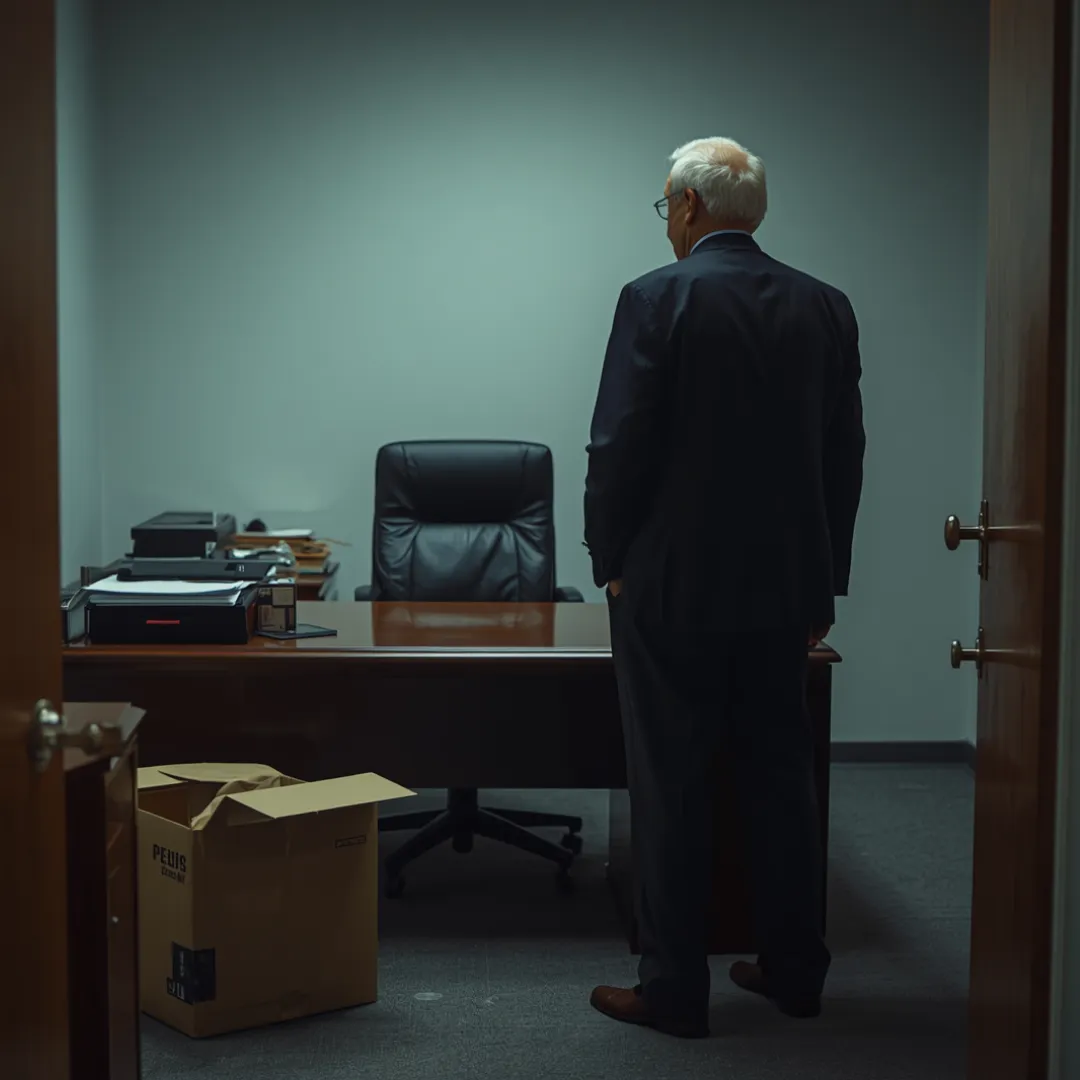
Nobody Said Thank You
I handed my business over on kind terms. Then I spent years quietly resentful — and I'm still not sure why.
You don't want to hand it over.
Some quiet part of you is dug in. And you've decided that makes you a bad parent. So you dress it up. You call it timing. You call it the market. You call it "they're just not ready yet."
Let me say the real thing first, so you can breathe. Not wanting to give your business to your child is not a crime. Some nights I think it's the most honest read you have.
I carried a version of this for years. I called it doubt. I called it patience. I called it good stewardship.
What I couldn't say out loud was smaller and heavier. Part of me didn't want to let go. And I was certain that made me a failure as a father.
So let's sit in that together. No mountaintop here. No five steps, no clean answer. Just two people at a kitchen table. It's late, and neither of us can sleep.
The handoff I actually made
I did hand a business over once. Not to a child, though. To two associates.
It was my wealth management practice. I built it over a long stretch of years. Then I handed it to them on terms that were kind. They put none of their own money in. They received a very valuable asset, and I received no money. I gave the firm to them.
Here's the part I'm not proud of. Before the handoff, I was unhappy. After the handoff, I was unhappier still.
Nobody said thank you. Nobody paused to weigh what had just changed hands. I kept waiting for a moment that never arrived. And the waiting curdled into a low, private resentment.
What I keep turning over
I'm still turning that over. I don't fully understand it, even now.
Was I owed a thank you? Maybe not. They earned their seats fair and square. But something in me wanted the transfer to be seen. I wanted the years to be counted, not just collected.
That's a strange thing for a grown man to admit. I gave a gift, then resented that it landed quietly. I still don't know what to do with that feeling.
What I've learned is not to trust the tidy version. The clean handoff on paper hides a lot underneath. It hid a lot in me.
The father I was while building
I should tell you something before I go further. I'm not a neutral narrator here. I've got skin in this, and scar tissue.
While I built my businesses, I was not good at home. I gave the best of myself to the work. My family got whatever was left, which wasn't much.
If I'm honest, the split was something like ninety-five and five. Ninety-five to the building. Five to the people I was building it for.
So there's a bitter joke buried in all of this. I built that gift by being absent from the very children it's for.
I'm seventy-three now. I can't go back and repair those years. I can only look at them squarely and tell you what I see.
And what I see complicates the whole question. Handing a business down can be love. It can also be an apology you never learned to say. Sometimes, God help us, it's both at once.
I don't get to stand above this and advise you. I'm down in the same ditch, working the same knot. That's the only honest place I know to write from.
The fear under the guilt
Let me go under the guilt for a minute. Because the guilt is loud. And loud things are usually covering something quieter.
Most owners who stall don't actually doubt the timing. They doubt the kid. They won't say it, even in their own heads. But it lives there.
You're not really scared of letting go. You're scared of what you'll have to watch. You picture the business sliding downhill. You picture a child who can't, or won't, meet what's coming.
That's the real fear. It isn't "am I a bad parent." It's "can they carry this, and must I watch if they can't."
I don't name that to shame you. I name it because naming it changes things. A fear with a name is a fear you can actually look at.
And here's the turn I keep circling back to. What if that read is not cruelty? What if it's just accuracy?
You know your child better than anyone alive. You've watched them since they were small. Maybe the reluctance isn't a wall. Maybe it's information you don't want to hold.
That's an uncomfortable thought. I'm not fully at home with it either. But it won't go away. So I'm keeping it on the table.
The trap in the reframe
Now, I know the trap in what I just said. A parent can call plain fear a "clear-eyed read." Contempt can dress up as discernment. I've seen that too, and it's ugly.
So I'm not handing you permission to write your kid off. That's not the move. The move is harder and quieter than that.
It's to look at your own reluctance and ask it one thing. Are you protecting the business, or protecting yourself? The answer isn't always flattering. Mine wasn't.
Rick's transition
I have a friend named Rick Kahler. He's a financial planner, and a thoughtful man.
Rick did the responsible thing. He found a successor inside his own firm. She was bright. She embraced the work completely. By every measure, she was the right choice.
Then the work itself changed her. She went so deep into the human side of money that she left. She walked off to become a full therapist.
Sit with that one. His own business converted his heir away from him. The thing he built pointed her toward a different life entirely.
I don't think Rick is at peace with it. I don't think he pretends to be, either. His transition didn't go the way he wanted. He's honest about the ache.
Here's what I keep seeing, over and over. The departing owner is often the unhappiest person in the room. The transition looks clean on paper. Underneath, it hurts.
What Rick is teaching me
Rick is teaching me something right now, whether he means to or not. He's showing me that a "successful" handoff can still break your heart. Doing it right does not spare you the grief.
And notice what actually happened to him. He didn't lose her to a competitor. He lost her to her own becoming. The work woke something up in her that pointed away from him.
That's not a failure of the plan. That's the plan working, and still hurting. I don't know what to call that. A thing that succeeds and wounds at once.
I don't have a fix for that grief. I'm not sure a fix exists. I think you carry it, and you keep playing through the changes.
When you let the child go
I've never freed a child from my own business. I didn't have that exact choice to make.
But I've watched it from the outside for decades now. And I've noticed something that genuinely surprised me.
Free your child to truly be who they are. Often, the business isn't it. Given real permission, they walk toward their own life. Not the one you built for them.
At first that looks like loss. For a while, it feels like loss. But keep watching a little longer.
Freeing the child seems to free the parent too. You stop guarding a handoff that was never going to fit. You get to go where you actually wanted to go.
I say this as a steward, not an expert. I have not mastered any of this. I'm just the person who's watched a lot of these up close.
And I'll be honest about the limit of my view. I'm seeing these from the outside. The insides of those families, I can only guess at.
But the pattern is too steady to ignore. The freed kid usually looks lighter. And, strange to say, so does the parent who freed them.
One I watched from the outside
I've watched a father hold on for a decade. He was sure the business was the gift of his life. His son took it because saying no felt impossible.
The son ran it dutifully and quietly went gray. He was competent. He was also somewhere else the whole time. You could see it in him at the holidays.
Then the father died, and the son sold within a year. Not out of spite. Out of relief he'd never been allowed to feel.
I don't tell that to scare you. I tell it because it haunts me a little. What if the kindest handoff that father could've made was none at all?
I genuinely don't know. Maybe the son needed those years. Maybe he'd tell the story differently than I just did. I only saw the outside of it.
The thing we get backward
Here's the one clean line I'll allow myself in this whole piece. We treat handing down and setting free as opposites. Most of the time, they are the same act.
You think you're withholding a gift. You may be handing them their own life instead.
The business was never really the inheritance. The permission to not want it — that might be the inheritance.
I can't prove that to you. I feel it more than I can defend it. But I've watched too many freed kids exhale to pretend I didn't.
Both of you are awake
Let me correct something, in case I made this sound one-sided. The owner is not the only one lying awake at 3 a.m.
The child is up too. Same hour, different bed, different fear entirely.
The parent is scared the child can't carry it. The child is scared the parent doesn't believe in them. Same silence. Opposite ends of it.
And here's the cruel part. A parent's hesitation feels like love from the inside. From the outside, to the child, it can read like a verdict.
The silence between them
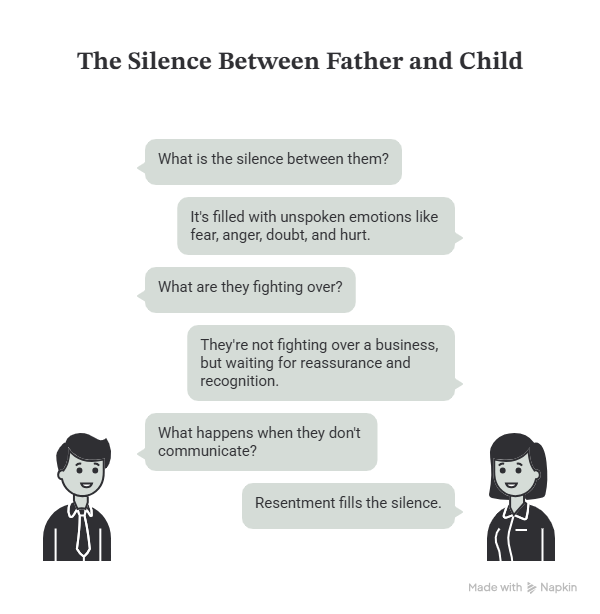
So there are two people. Both scared. Both a little angry. Both convinced the other one has it easy.
Neither of them saying the true thing out loud. The father won't admit his doubt. The child won't admit the hurt.
I've come to think the transition isn't a transaction at all. It's two frightened people, trying to hand each other permission. And usually fumbling the pass.
They're not fighting over a business. They're both waiting to be told they're okay. The owner wants his years honored. The child wants to be believed in.
Nobody says any of it. So the resentment fills the silence instead. I did exactly that, in my own way, waiting for a thank you.
What a kinder handoff might ask
I don't have a system for this. Please don't take what follows as a checklist. Take it as a person thinking out loud.
Maybe the first move isn't legal. Maybe it's a conversation nobody wants to start. The one where you say the scared thing first.
What if the owner said it plainly? "Part of me doesn't want to give this up." Not as a weapon. Just as the truth on the table.
What if the child got to answer just as plainly? "Part of me isn't sure I even want it." Imagine the relief in that room.
I think most families never get near that conversation. They negotiate valuations instead. They talk multiples and taxes and timelines. They never once talk about the fear.
The part I'd fail at
I'm not sure I could have that conversation myself. I'm better at it on paper than in person. That's a confession, not advice.
But I keep wondering what would have changed for me. If someone had simply said, "Josh, I see what this cost you." I might not have needed the thank you at all.
And maybe that runs both directions across the table. Maybe the child is waiting for a sentence too. Something like, "I know you're scared I'll drop it." Named out loud, a fear gets smaller. Left in the dark, it just grows teeth.
I keep picturing all the families who never say either sentence. They sign the documents and shake hands. Then they spend years quietly wondering what the other one really felt.
What I'm still stuck on
I promised to stay honest, so here's exactly where I am. I'm not standing on the far side of this. I'm still in it.
I don't know if my old resentment was fair. I don't know if a thank you would have fixed it. I suspect, most days, that it wouldn't have.
I don't know if reluctance is love or fear. I think, most nights, it's both wearing each other's coat.
What I've stopped believing is that the reluctance makes you bad. It might just make you awake. It might be the most careful look you've ever taken at your child.
I keep thinking about Rick, doing everything right, still aching. I keep thinking about those freed kids, walking off lighter. I keep thinking about my own quiet, unthanked handoff.
None of it resolves into a lesson. Believe me, I've tried to force it. The pieces won't sit still long enough to preach from.
Here's what the dual cancer has done to my clock. It's made every unhanded thing feel louder. The business, the apologies, the years with my kids.
You'd think a diagnosis would hand you clarity. Mostly it just turns up the volume. The questions get bigger, not smaller, near the end.
So I'm not asking you to hurry your handoff. I'm asking you to stop lying about it. To yourself, first, and then maybe to them.
So I'm not going to tie a bow on this. I don't have the bow. I'm not sure the bow would be true.
I'll just ask the question with you, here at the table, late. Is your reluctance a failure of love? Or is it the most loving, most accurate thing you know about them?
I honestly don't know. Some nights I lean one way, some nights the other. But I'd rather sit inside that question than fake my way past it.
Maybe that's the whole job, at our age. Not to answer it. Just to stop pretending we already have.
Your turn
If you're the owner, tell me what you can't say out loud. If you're the child, tell me what you wish they knew. I read every comment. I answer the honest ones first.
Hey, this is Josh. You're on the Long Strange Trip. I'm glad you're here.

Facebook
LinkedIn
Youtube