
The Only Place Life Actually Happens: A Journey to Living in the Now
Here’s something that took me way too long to figure out: I spent most of my life living everywhere except where I actually was.
I’d replay past business deals that went sideways, running through all the ways I got screwed over or should have done things differently. Or I’d fast-forward to some imagined future – dreaming about the next big win or, these days, catastrophizing about medical outcomes that may never happen.
Meanwhile, the present – the only place where anything actually happens – would just slip by unnoticed.
I’m still learning this lesson. Still catching myself drifting into past resentments or future anxieties. But the journey toward presence has changed everything about how I experience my life. Let me share how I got here, and maybe you’ll recognize parts of your own journey in mine.
The Ordinary World: Living Everywhere But Now
For most of my business career, I lived in what I call “temporal displacement.” That’s a fancy way of saying I was never actually where I was.
In meetings, I’d be replaying the last deal that fell through or planning my pitch for the next prospect. At home, I’d be mentally at the office, solving problems that didn’t need solving right then. On vacation, I’d be worrying about what was happening back at work. And my children were the big losers as well as I.
I thought this was normal. I thought this was what “driven” people did. We were always processing the past to avoid repeating mistakes, always planning the future to stay ahead of the game.
Except it didn’t work that way.
The past I kept replaying never changed. And the future I kept planning for rarely showed up the way I imagined it. Meanwhile, the present – where my actual life was happening – kept slipping away unnoticed.
I convinced myself I was being strategic, analytical, and prepared. Really, I was just avoiding being fully alive in the moment I was actually in.
The Call to Adventure: When the Client Fell Asleep
Sometimes the universe sends you a message you can’t ignore.
I was trying to renew a food service contract. Big potential client. Important meeting. We’d prepared what I thought was a solid presentation.
And about twenty minutes in, right after lunch, the decision-maker literally fell asleep.
Not dozed off. Full-on asleep. During my pitch.
I was mortified. Embarrassed doesn’t begin to cover it.
But here’s what I did with that experience: I refused the call to learn from it. Instead, I blamed him. Convinced myself he was an anti-semitic jerk (which, to be fair, he probably was). Told myself the whole thing was rigged from the start. Spent years carrying around anger about how unfairly we’d been treated.
This is what refusing the call looks like in real life. The universe hands you a clear lesson – don’t schedule important presentations right after lunch, pay attention to what the market is telling you about your business, notice when it’s time to make a change – and you turn it into a story about someone else’s failings instead.
Meeting the Mentor: The Account That Taught Me Nothing (At First)
I had another powerful teacher show up disguised as a loss.
We lost what I considered an important account. I was convinced they’d made a terrible decision. Felt personally betrayed. Spent countless hours angry at the person who discontinued doing business with us. Built an entire narrative about how wrong they were and how right we were. I did this, and you might think I had a right to feel the way I did if you knew the whole story. (I don’t have space to tell it here.)
This went on for years.
Years of mental energy spent on something that was over and done. Years of resentment and righteous anger. Years of dwelling in a past I couldn’t change.
The mentor was there the whole time, and I never would have thought of him as a mentor because I believed he was a liar and unethical; I just couldn’t see him. Waiting for me to see the lesson: in their mind, they were doing what was best for their company. They weren’t thinking about what was fair to my company or me personally. They were making a business decision based on what they believed served their interests.
But I couldn’t hear the mentor’s voice because I was too busy being the victim in my own story.
Crossing the Threshold: The Thirty-Year Education
It took me about thirty years to start crossing the threshold into presence.
Thirty years of living in the past, dwelling on old resentments, replaying failures, and nursing wounds that should have healed decades earlier.
Thirty years of living in the future, building elaborate dreams or, depending on the day, elaborate catastrophes.
And then, slowly, I started noticing a pattern: all that time spent in the past or future changed exactly nothing about what was actually happening in my life.
The past stayed the same no matter how many times I replayed it. The future remained unknowable no matter how much I planned or worried about it.
The only thing that changed was how much of my actual life I was missing while I was mentally somewhere else.
This realization didn’t arrive as a lightning bolt. It crept in gradually, through the books I read, the conversations I had, the mistakes I kept making, until I finally couldn’t ignore the pattern anymore.
Tests, Allies, and Enemies: Learning What Stays and What Goes
As I started trying to be more present, I discovered that my own mind was both ally and enemy.
The enemy part was obvious: my brain loved living in the past and future. It had spent decades perfecting those habits. It didn’t want to give them up.
Every time I caught myself dwelling on old resentments, I’d have to consciously redirect. Every time I found myself catastrophizing about the future, I’d have to pull myself back to now.
This was exhausting at first. It felt like I was fighting myself constantly.
But I also discovered allies in this journey. I found Eckhart Tolle’s teaching about the power of now, which gave me a framework for understanding what I was experiencing.
The Wisdom of Eckhart Tolle: A Map for the Journey
Tolle’s central insight is deceptively simple: the present moment is all you ever have.
Not in some mystical or abstract way, but as a literal fact. You cannot live in the past – it’s gone. You cannot live in the future – it doesn’t exist yet. The only place you can actually be is now.
But here’s what makes Tolle’s teaching powerful: he doesn’t just tell you to “be present” as if that’s some simple mindset shift. He helps you understand how the mind creates suffering by constantly pulling you out of the now.
When you’re dwelling on the past, you’re usually reinforcing some identity as a victim or rehearsing old resentments. When you’re lost in the future, you’re usually either chasing some imagined salvation or running from some imagined catastrophe.
Neither of these mental activities serves you. They just keep you from experiencing the life you’re actually living.
Tolle taught me to notice when I’d left the present moment and to simply come back. Not with judgment or frustration, just with gentle redirection: “Oh, I’m thinking about the past again. What’s actually happening right now?”
This practice has become one of the most valuable tools I have for navigating life’s challenges. But I’m still learning it. Still practicing it. Still discovering how much I miss when I’m mentally somewhere else.
The Ordeal: When Cancer Forced Me to Face the Future
Then came the real test of everything I’d been learning.
Two aggressive cancers simultaneously. A brain bleed. Treatments with uncertain outcomes. Survival statistics that weren’t particularly encouraging.
Suddenly, the future wasn’t some abstract thing to dream about or worry about. It was a very real, very limited thing that might be much shorter than I’d assumed.
And here’s what I discovered: dwelling on that future – all the medical outcomes that might or might not happen, all the scenarios that could play out, all the ways this could go wrong – served absolutely no one. Especially not me.
I could spend my time imagining every possible progression of disease, every potential complication, every worst-case scenario. Or I could ask: What’s actually true right now? What can I do today?
The cancer exists. The treatments are coming. The outcome is uncertain. Those are facts.
But when I find myself spinning out into the future, imagining how bad it might get or whether I’ll see 75 or 80, I’m not doing anything useful. I’m just torturing myself with possibilities that may never happen.
And here’s the thing about mortality that nobody tells you: when you’re genuinely facing the reality that your time is limited, you realize how much time you’ve wasted being mentally absent from your own life.
All those years dwelling on past business disappointments? What a waste. All those hours planning and worrying about futures that never arrived the way I imagined? What a waste.
The only thing that isn’t a waste is being fully present for whatever time I actually have.
This doesn’t mean I don’t plan. I still have medical appointments to attend, treatment decisions to make, and practical arrangements to handle. But I keep the time frame close. What matters today? What decision needs to be made this week? What can I actually do right now?
The far-off future – the one my brain wants to fill with either dreams or nightmares – that doesn’t exist. It’s just stories. And spending my present moments lost in those stories means I’m missing the life I’m actually living.
The Reward: Discovering Where Power Actually Lives
Here’s what I’ve learned through this journey: the present moment is the only place you have any power.
You can’t change what happened yesterday. You can’t control what happens next year. But right now? Right now, you can make a choice. Take an action. Have a conversation. Write something. Learn something. Connect with someone.
All your agency lives in the present.
When you’re stuck in the past, you’re powerless – you’re just rehearsing things you can’t change. The client who fell asleep during my pitch? Still asleep, no matter how many times I replay it. The account we lost? Still lost, no matter how much I resent it.
When you’re lost in the future, you’re powerless – you’re just imagining things that may never happen. My cancer might progress in any number of ways, but worrying about all those possibilities today doesn’t change tomorrow’s reality.
But when you’re present? That’s where you can actually do something.
This is the treasure I’ve found on this journey: presence isn’t just some spiritual practice or mindfulness technique. It’s where your actual life is happening. It’s where wisdom accumulates through real experience rather than imagined scenarios.
Every moment I spend fully present is a moment I’m actually alive. Every moment I spend lost in the past or future is a moment of life I’ve missed.
The Road Back: Practicing Presence Daily
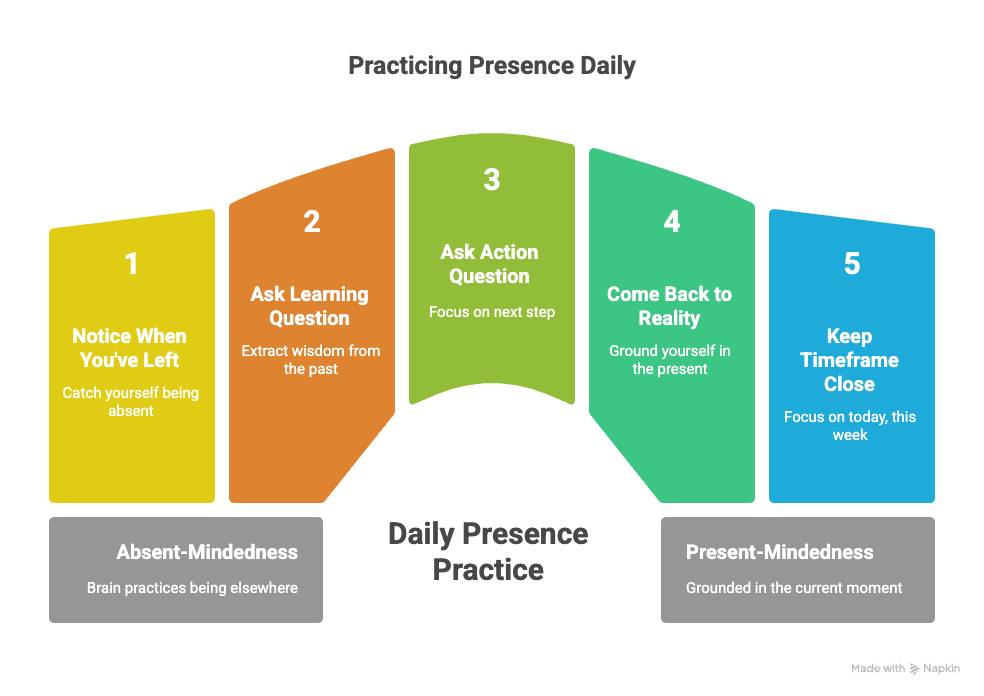
So what does this actually look like in daily life? How do you stay present when your brain has spent decades practicing being somewhere else?
I’m still figuring this out. Still learning. But here’s what I’m discovering works:
Notice when you’ve left. The first step is just catching yourself. When you realize you’re replaying an old conversation or imagining some future scenario, just notice it. No judgment. Just: “Oh, I’m not present right now.”
Ask the learning question. If you’re in the past, ask: “What did I learn from this?” Not to analyze it to death, just to extract the useful wisdom and then let it go.
That sleeping client taught me about timing and reading the room. It also signaled market conditions I should have been paying attention to. Once I extracted those lessons, I could let go of the resentment.
The lost account taught me that everyone acts in their own interest, and taking business decisions personally is a waste of energy. That’s wisdom I can use. The anger and sense of betrayal? That serves nothing.
Ask the action question. If you’re in the future, ask: “What’s the next step I can take right now?” Not “How will this all work out?” or “What if everything goes wrong?” Just: “What can I do today?”
With my cancer situation, this means: What’s my next medical appointment? What decision needs to be made this week? Who do I want to spend time with today?
Come back to what’s actually true right now. What are you doing in this moment? What can you see, hear, and feel? This isn’t about being Zen or mindful in some mystical way. It’s just about grounding yourself in the reality of where you actually are.
Keep the time frame close. When you’re planning or thinking ahead, keep it close. What matters today? This week? This month? The further out you project, the more you’re dealing with imagination instead of reality.
I’ve noticed that when I think too far ahead these days, I just end up dwelling on the end of my life. That’s not useful. It doesn’t help me make better decisions. It doesn’t improve my quality of life. It just steals the present moment from me.
Return with the Elixir: The Wisdom of Presence
I’m sharing this journey not because I’ve mastered presence. I haven’t. I still drift into the past. I still worry about the future.
But I’m learning, and I think this learning might be valuable to share as we explore it together.
The wisdom I’m discovering is this: living in the present isn’t about achieving some perfect state of mindfulness. It’s about recognizing that the only place you can actually live is now. The only place you have power is now. The only place wisdom accumulates is through presence with what’s actually happening, not through dwelling on what happened or worrying about what might happen.
When you spend years dwelling on past resentments, you don’t gain wisdom from those experiences. You just reinforce suffering. But when you extract the lesson and let the rest go, that’s when experience becomes wisdom.
When you spend your energy imagining or catastrophizing about the future, you don’t prepare yourself for what’s coming. You just exhaust yourself with scenarios that will probably never happen. But when you focus on what you can do right now, you’re building the capacity to respond to whatever actually shows up.
This is especially true with something like cancer. I can spend all my time worrying about whether I’ll see 75, whether treatment will work, whether the cancer will progress. Or I can ask: What’s actually true today? What can I do with the time and energy I have right now?
The second approach doesn’t guarantee better medical outcomes. But it guarantees I’m actually living the life I have instead of missing it while I worry about the life I might lose.
Questions for Fellow Travelers
I don’t have this figured out. I’m learning as I go, making mistakes, catching myself dwelling in past or future, and trying again.
But I’m curious about your experience:
Where do you spend most of your mental energy – in the past, the future, or the present?
What past resentments or regrets do you replay that keep you from being fully present? What did those experiences teach you that you can extract and use, so you can finally let the rest go?
What future scenarios – dreams or catastrophes – do you spend time imagining? What real action could you take today instead of dwelling on those imagined futures?
I’d love to hear your stories. Share in the comments about times when living in the past or future got in the way of your happiness or effectiveness. What helped you come back to the present? What are you still struggling with?
Because here’s what I believe: we’re all on this journey together. None of us has it perfectly figured out. But by sharing our experiences – our failures and small victories, our insights and continued struggles – we help each other find the way.
The present moment is where life actually happens. It’s where wisdom accumulates. It’s where we have power to make choices and take action.
Everything else is just stories we tell ourselves while life passes by.
What’s your story? And what wisdom have you found in learning to be present?
Let’s figure this out together.

Facebook
LinkedIn
Youtube